
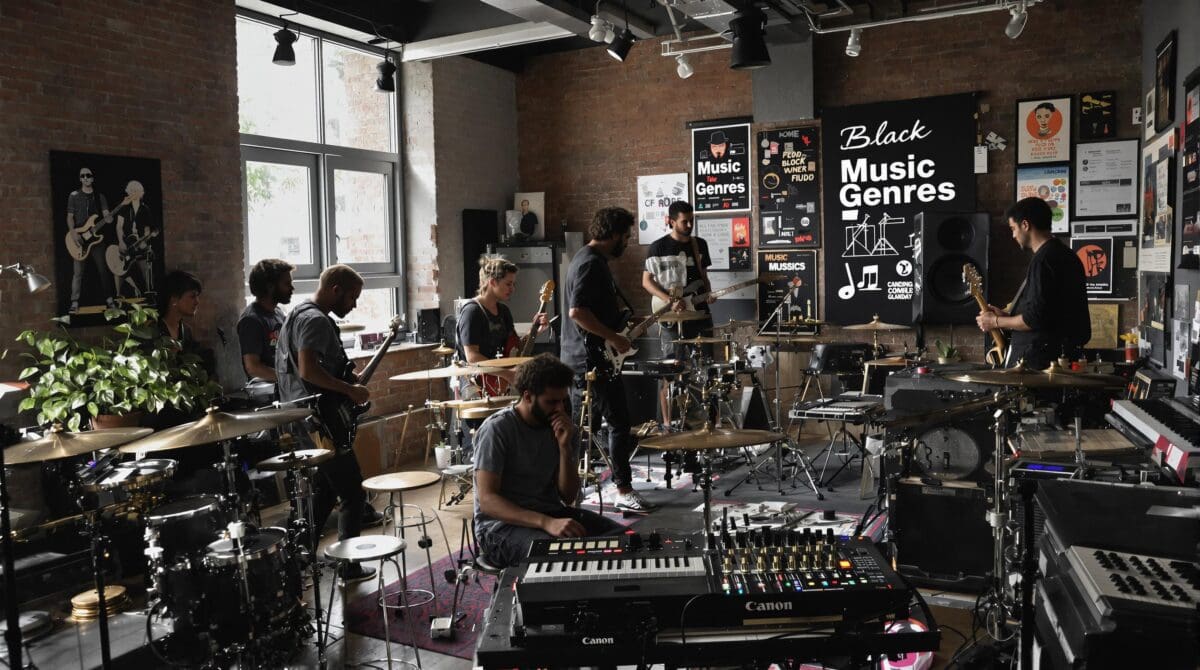


Music genres are much more than simple labels or categories. Here is something unexpected. Pluggnb, a new hybrid genre, saw an astonishing 342.8 percent surge in digital downloads reaching nearly 700,000 tracks in 2025 alone. Yet the real surprise is that nostalgia and spiritual music are quickly overtaking traditional styles and reshaping how both artists and listeners connect. That shift will catch even seasoned musicians off guard.
Table of Contents
- Understanding The Main Music Genres
- How Genres Influence Songwriting And Production
- Choosing The Right Genre For Your Project
- Trends And Emerging Genres In 2025
Quick Summary
| Takeaway | Explanation |
|---|---|
| Genres are evolving cultural expressions | Music genres reflect the emotions, experiences, and social contexts of different communities, showcasing their dynamic and transformative nature over time. |
| Genre selection aligns with personal identity | Choosing the right genre connects deeply with an artist’s psychological profile and emotional resonance, influencing authenticity and creativity in their music. |
| High production quality enhances emotional impact | The quality of music production significantly affects listeners’ emotional responses; understanding distinct production methods for each genre can elevate artistic connections. |
| Hybrid genres are a growing trend | The fusion of different musical styles, like the emergent pluggnb genre, highlights a cultural appetite for innovative sounds that challenge traditional genre boundaries. |
| Nostalgia influences current musical trends | The resurgence of past musical styles, such as early 2000s pop, shows a public longing for familiar sounds, creatively reinterpreted for contemporary audiences. |
Understanding the Main Music Genres
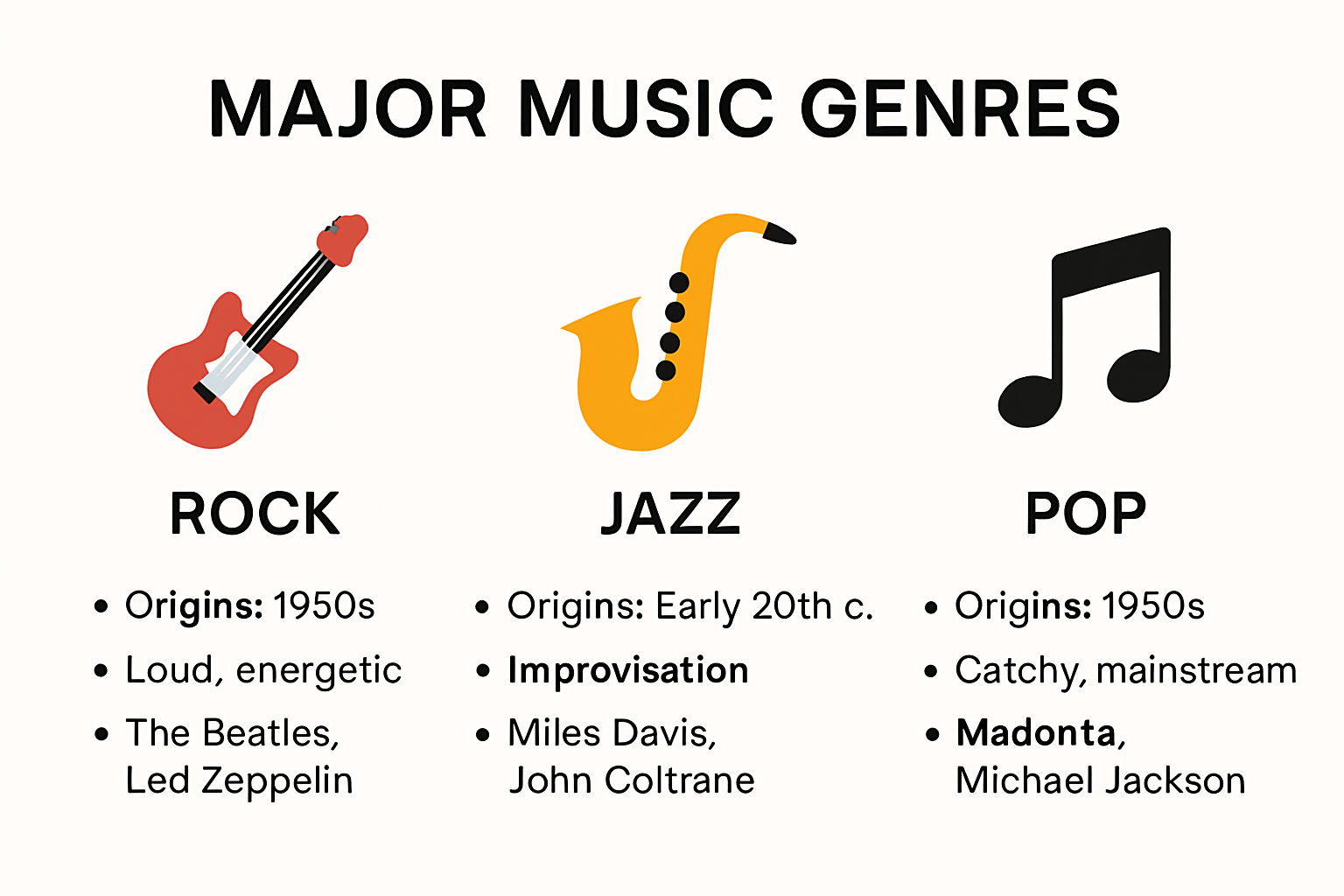
Music genres represent more than just sound classifications. They are living, breathing cultural expressions that reflect the emotions, experiences, and social contexts of different communities and generations. Exploring these genres provides insight into the complex tapestry of musical evolution and human creativity.
The Core Musical Landscapes
Understanding music genres requires recognizing their dynamic nature. According to a fascinating Time Magazine study, three major musical revolutions have dramatically transformed popular music between 1960 and 2010: the “British Invasion” of 1964, technological shifts in 1983, and the emergence of hip-hop in 1991.
These transformative moments highlight how genres are not static categories but evolving systems of musical expression. Each genre carries unique characteristics that distinguish its sound, rhythm, instrumentation, and cultural significance. From the raw energy of rock to the introspective melodies of folk, genres provide artists with a framework for creative exploration.
Here is a table summarising the three major music revolutions and their impacts, as mentioned in the article:
| Musical Revolution | Year | Key Change or Genre(s) | Impact on Popular Music |
|---|---|---|---|
| British Invasion | 1964 | Rock/Pop | Globalisation of pop/rock, transformation of mainstream |
| Technological Shift | 1983 | Electronic/Pop | Introduction of synthesizers, new production techniques |
| Emergence of Hip-Hop | 1991 | Hip-Hop/Rap | Shift to beat-driven music, increased diversity and fusion |
Educational Background and Genre Preferences
Interestingly, research reveals a compelling connection between musical education and genre preferences. A study published in Sage Journals discovered that individuals with formal music training tend to appreciate more complex genres like jazz and classical music. Conversely, those without such educational background often gravitate towards rap, hip-hop, and pop-rock.
This finding underscores the nuanced relationship between musical knowledge and genre appreciation. It suggests that understanding a genre goes beyond simply listening – it involves comprehending its historical context, technical complexity, and cultural significance.
The table below compares how educational background influences genre preferences as described in the content:
| Educational Background | Preferred Genres |
|---|---|
| Formal Music Training | Jazz, Classical |
| No Formal Musical Background | Rap, Hip-Hop, Pop-Rock |
Generational Musical Trends
The musical preferences of younger generations offer another fascinating lens for understanding genre dynamics. Research examining students aged 9-19 found that classical popular music and rock consistently ranked as the most preferred genres. Meanwhile, classical art music and traditional folk music received lower preference scores, indicating a clear generational shift in musical taste.
These trends demonstrate how genres continuously adapt and transform. What resonates with one generation might feel outdated to another. Artists and producers must remain attuned to these evolving preferences while staying true to their creative vision.
Ultimately, music genres are more than mere labels. They are living narratives that capture human emotion, social movements, and collective experiences. By understanding their complexity, artists can create music that transcends traditional boundaries and speaks directly to listeners’ hearts.
How Genres Influence Songwriting and Production
Music genres are not just labels but powerful frameworks that profoundly shape the creative process of songwriting and music production. Each genre carries its own intricate set of rules, expectations, and stylistic nuances that guide artists in crafting their sonic landscapes.
Instrumental Complexity and Artistic Evolution
Research examining musical development reveals fascinating insights into how genres evolve. A groundbreaking study from ArXiv discovered that as a genre attracts more artists, its instrumental variety increases dramatically. This means that genres become more complex and diverse over time, with musicians continually pushing boundaries and experimenting with new sounds.
However, the same research uncovered an intriguing paradox. While instrumental complexity grows during a genre’s creative phase, album sales typically rise with decreasing complexity. This suggests that once a genre reaches mainstream success, it often becomes more formulaic, trading innovative exploration for commercial appeal.
Production Quality and Emotional Impact
The relationship between music production and emotional resonance is profound. According to research published in ArXiv, production quality significantly influences listeners’ emotional responses. High-quality mixing and production techniques can dramatically enhance a song’s ability to connect with audiences, particularly for listeners with refined musical sensibilities.
Different genres demand distinct production approaches. A jazz recording requires a completely different mixing strategy compared to a heavy metal track. Producers must understand each genre’s unique sonic characteristics, from the warm, organic sounds of acoustic folk to the crisp, layered textures of electronic dance music.
Genre Expectations and Creative Boundaries
Genres create both limitations and opportunities for artists. While some musicians view genre constraints as restrictive, others see them as creative challenges that inspire innovation. Rock musicians might experiment with progressive structures, while hip-hop producers continuously push sampling and beat-making techniques.
Each genre has its own set of unwritten rules. Blues demands authenticity and emotional depth. Electronic music prioritizes sound design and rhythmic precision. Classical compositions require intricate musical notation and formal structural understanding. Successful artists learn to navigate these expectations while finding their unique voice.
Understanding genre influences is crucial for artists seeking to communicate effectively through music. Genres provide a shared language, helping musicians connect with audiences who recognize and appreciate specific musical traditions. By mastering genre conventions and knowing when to respectfully challenge them, artists can create music that feels both familiar and refreshingly original.
Ultimately, genres are not prison cells but launching pads for creative expression. They offer a rich, complex framework within which musicians can explore, experiment, and ultimately transform musical landscapes.
Choosing the Right Genre for Your Project
Selecting the right genre for a musical project is a nuanced decision that extends far beyond personal preference. It involves understanding your artistic identity, target audience, and the unique emotional landscape of different musical styles.
Personal Psychological Alignment
Research suggests that genre selection is deeply connected to individual personality traits. A fascinating study published in Europe PMC revealed that individuals with high openness to experience tend to gravitate towards more complex and novel music genres like classical and jazz. This indicates that artists should carefully consider their own psychological profile when choosing a musical direction.
Your innate creative tendencies can significantly influence which genre will feel most authentic. Some musicians naturally resonate with introspective singer-songwriter styles, while others thrive in high-energy electronic or punk environments. Understanding your personal musical DNA helps ensure that your chosen genre feels like a natural extension of your artistic self.
Cultural and Emotional Resonance
Genres carry profound emotional and cultural significances. Research from Frontiers in Psychology exploring music preferences demonstrated that different genres are associated with distinct psychological characteristics. This means selecting a genre isn’t just about sound – it’s about connecting with specific emotional landscapes and cultural narratives.
Each genre communicates unique emotional experiences. Blues expresses deep pain and resilience. Electronic music often represents technological optimism. Folk music frequently carries messages of social commentary and community connection. Your chosen genre becomes a powerful vehicle for storytelling and emotional expression.
Adaptability and Genre Evolution
Successful artists understand that genres are not static entities but dynamic, evolving systems. A compelling study from ArXiv tracked how genres like new wave and disco experienced complex instrumental transformations during the 1970s, ultimately reverting to simpler forms. This research underscores the importance of flexibility and adaptability in musical creation.
While respecting genre conventions, innovative musicians continuously push boundaries. They understand that genres are frameworks for creativity, not restrictive rules. The most exciting musical moments often occur when artists skillfully blend genre characteristics or introduce unexpected elements.
Choosing the right genre requires honest self-reflection, deep musical knowledge, and a willingness to experiment. Consider your technical skills, emotional range, performance strengths, and the audiences you wish to connect with. Remember that genre is a starting point, not a limitation.
Ultimately, the most compelling music emerges when artists find the perfect intersection between their authentic voice and their chosen genre’s expressive potential. Trust your creative instincts, study the nuances of your preferred styles, and never be afraid to challenge traditional genre boundaries.
Trends and Emerging Genres in 2025
The musical landscape of 2025 represents a fascinating intersection of technological innovation, cultural shifts, and creative cross-pollination. Artists and producers are witnessing unprecedented genre transformations that challenge traditional musical boundaries.
Hybrid Genre Innovations
In 2025, genre fusion has become more than a trend – it’s a fundamental approach to musical creation. According to Midia Research, the genre pluggnb emerged as a groundbreaking hybrid, blending trap’s subgenre plugg with 1990s R&B aesthetics. This innovative style saw an extraordinary 342.8% increase in digital downloads, rising to 699,987 tracks, demonstrating listeners’ appetite for genre-blending experiences.
These hybrid genres reflect a broader cultural desire for musical experiences that defy traditional categorisation. Musicians are increasingly viewing genre boundaries as flexible frameworks rather than rigid constraints, creating sonic landscapes that challenge listeners’ expectations.
Nostalgic Resurgence and Reimagination
Interestingly, 2025 has witnessed a compelling resurrection of past musical styles. Associated Press reported a significant resurgence of early 2000s pop music, dubbed “recession pop.” On-demand audio streams of pop music from that era increased by 6.4%, suggesting a public yearning for nostalgic sounds during uncertain socio-economic times.
This trend goes beyond mere repetition. Artists are reinterpreting classic sounds through contemporary production techniques, creating a nuanced dialogue between musical past and present. The result is a rich, layered musical experience that feels both familiar and innovative.
Spiritual and Emotional Genres
Another remarkable trend in 2025 is the rising prominence of spiritually oriented music. Associated Press highlighted the significant growth of Christian and gospel music, particularly among younger, predominantly millennial audiences. Artists like Forrest Frank, Brandon Lake, and Elevation Worship have been instrumental in driving this genre’s popularity.
This trend suggests a deeper societal shift towards music that offers emotional depth, community connection, and spiritual exploration. Listeners are seeking genres that provide not just entertainment, but meaningful emotional and philosophical experiences.
The musical landscape of 2025 demonstrates that genres are living, breathing entities. They are no longer static classifications but dynamic, evolving forms of cultural expression. Artists who understand this fluidity can create music that resonates across traditional boundaries, speaking to listeners’ complex emotional and cultural experiences.
As technological tools become more sophisticated and global cultural exchanges intensify, we can expect even more radical genre transformations. The future of music lies not in rigid categorisation, but in creative exploration, emotional authenticity, and the courage to challenge existing musical paradigms.
Frequently Asked Questions
What are music genres, and why are they important?
Music genres are classifications that define the style and cultural context of music. They are important because they shape listeners’ expectations, influence artists’ creative processes, and reflect cultural expressions throughout history.
How do genres affect songwriting and production?
Genres provide a framework for songwriters and producers, dictating stylistic choices and production techniques. Each genre has its unique rules regarding instrumentation, emotional delivery, and technical production methods that guide the creative process.
Why do artists often blend different genres in their music?
Artists blend genres to create innovative sounds that appeal to diverse audiences. This fusion reflects a cultural desire for originality and pushes the boundaries of traditional categorizations, leading to the emergence of hybrid genres like pluggnb.
What are some current trends in music genres for 2025?
In 2025, notable trends include the rise of hybrid genres, a resurgence of nostalgic sounds from the early 2000s, and an increase in spiritually oriented music, reflecting listeners’ desires for deeper emotional connections and meaningful experiences.
Redefine Your Genre: Turn Musical Vision into Real Industry Success
Are you struggling to transition your genre innovation into real-world exposure? The article reveals how modern genres are more fluid than ever, yet the biggest challenge for artists is breaking past industry gatekeeping and pushing their sound beyond traditional boundaries. If you are experimenting with hybrid styles like pluggnb, or tapping into the nostalgic and spiritual trends reshaping 2025, you need more than talent alone to make an impact.
Do not let your project stay unheard. Harness professional support tailored for new genres at Music Gateway. Our platform helps you take control of distribution, playlist promotion, digital advertising and sync licensing—making it easy to reach audiences worldwide and stay ahead in a fast-evolving music scene.
Join artists who turned diversity and authenticity into lasting careers. Connect your creative vision with opportunity now at Music Gateway and begin your journey from independent artist to industry contender.